
















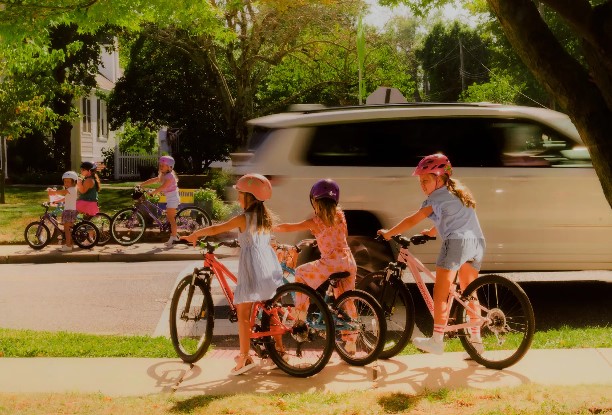
Molly Moscatiello, age 7, started riding her bike to first grade last year. There’s a crosswalk with no crossing guard, “and I had to look both ways like five times,” she says, two grown-up teeth peeking through the gap in the front of her smile. Sometimes her parents’ friends would drive past and ask if Molly needed a ride, but she’d always wave them off. “I felt a little nervous at first,” she says. “But then after a while I felt comfortable by myself.” Soon, other kids began asking to ride their bikes to school. By the end of first grade, Molly was leading a small cohort of five or six, riding to school together in Little Silver, N.J.
Twenty years ago, this would be as unremarkable as kids eating ice cream or playing soccer. But these days, when only about one in 10 American children walk or bike to school, Molly and her friends are more than just a gaggle of kids on bikes. They’re part of a growing countermovement against the technification of American childhood.
Molly’s mother, Holly Moscatiello, is the founder of The Balance Project, a parent-run nonprofit working to rebuild communities to encourage childhood independence and get kids off screens. “We want to make it just as easy to experience life in our community as it is to go on your phone,” Moscatiello .
In Nov. 2024, Moscatiello invited six other parents in Little Silver to her home to discuss the problem. Later that month, that small group hosted a kickoff meeting for the broader community. They expected around 20 people might come. Sixty showed up. “There was a collective sense of: there’s a problem,” Moscatiello recalls, “but what do we do about it?” The answer, the parents decided, is as much cultural as it is technological. The group agreed to advocate for device-free schools, delay buying phones for their kids for as long as possible, and restrict social media until late adolescence. But they also realized they can’t raise their children in an entirely tech-free world.
So instead of railing against technology, they’re focused on making the physical world as accessible and appealing as possible. “We envision a future where a healthy balance between real life and technology is the norm,” Moscatiello says. The group believes that 25% is a kind of community tipping point: if they can get a quarter of families to reduce devices and a quarter of kids to play outside, then others will follow. Protecting her own kids, Moscatiello thinks, isn’t just about monitoring their screen time. It’s about building an analog community that can compete with the digital one.
In a way, the parents in the Balance Project are on a mission to rebuild the phone-free communities they had growing up. “We had an analog childhood and a digital late-adolescence,” says Moscatiello. “We have to preserve what we had before. If we don’t do it, who will?” She says that 60 other Balance Project groups have formed around the country, everywhere from Arizona to Georgia to Oregon.
The Balance Project is lobbying their local school district to enforce their device-free policy by banning smartwatches during school. They’re pushing their school board for more outdoor recess, asking them to reduce recreational screen time at school, and want to walk back pandemic-era screen reliance during class. They’re planning to “keep showing up to board meetings and keep asking questions” says Moscatiello.
The Balance Project also draws heavily on the philosophy of Let Grow, a national non-profit promoting childhood independence. When she first pioneered the idea of “free range” parenting in 2009, Let Grow President Lenore Skenazy got fearful feedback from other parents. What if kids are abducted when they’re walking alone around the neighborhood? But in recent years, Skenazy says, something has changed. “It’s not that that fear has abated, it’s that other fears have superseded it,” she says. “And one of those is our children’s mental health.”