
















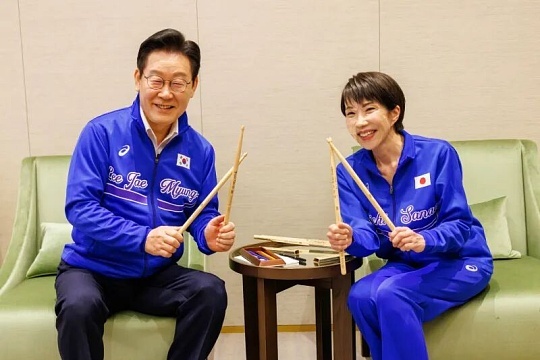
In Tokyo and Nara this week, an unexpected scene unfolded in one of Asia’s most sensitive bilateral relationships: South Korean President Lee Jae-myung and Japanese Prime Minister Sanae Takaichi took center stage, donned sports jackets, and together played the beats of the K-pop hit “Dynamite.”
For Washington, which has long been anxious about discord among its Indo-Pacific allies, this is undoubtedly a positive signal. Following the dramatic upheavals of the previous administration, the newly elected South Korean president, once labeled a “pragmatist,” is now seeking balance within the U.S.-Japan-South Korea trilateral security framework in a highly personalized way.
A Pragmatic Shift Beyond the Shadow of History
Lee Jae-myung has long been viewed as a populist with a tough stance toward Japan. However, since his early election in June 2025, he has displayed a surprising degree of strategic flexibility. This visit to Japan marks his second face-to-face interaction with Sanae Takaichi in a short period, following their meeting in Gyeongju last October.
For the United States, the most important observation is whether Lee will continue the momentum of improving relations with Japan that his predecessor initiated. The answer appears to be yes, albeit through a different path. Rather than simply repeating past demands for apologies, Lee has shifted the focus to “future-oriented cooperation,” including hydrogen energy, artificial intelligence, and establishing stable industrial and supply chains in the complex international order. This strategy of “separating politics from economics” effectively seeks to create a buffer against tariff pressures in the Trump era and China’s challenges in the semiconductor sector.
Balancing Between the U.S. and China
Just a week before his visit to Japan, Lee Jae-myung concluded a large-scale state visit to Beijing. In Washington’s view, the sequence of “choosing Beijing for the first visit of the year and Japan for the second” fully reflects the “shuttle diplomacy” of his diplomatic team.
In Tokyo, he not only discussed follow-up measures regarding historical forced labor issues but also reiterated in a joint statement the commitment to the complete denuclearization of the Korean Peninsula. Although Lee’s public remarks on “U.S.-Japan-South Korea security cooperation” were more cautious than Japan’s (Japan mentioned it four times, he only once), he emphasized the necessity of trilateral communication among South Korea, China, and Japan. This approach aims to reduce the sense of being caught between Washington and Beijing while ensuring Seoul’s autonomy in regional affairs.
The Signal Behind the Beats
The most symbolic moment occurred in Nara. Japanese Prime Minister Takaichi, a heavy metal enthusiast, invited Lee, who had never played drums before, to an impromptu performance. Lee later took to social media, calling it a “childhood dream.”
This “drum diplomacy” was not merely a display of goodwill. At a time when U.S.-Japan-South Korea relations face internal discord due to U.S. economic pressure on its allies, the synchronized beats of the South Korean and Japanese leaders—even on the drums—sent a firm message to the outside world: amid the increasingly turbulent situation in Northeast Asia, these two democracies are attempting to build more direct trust by bypassing cumbersome traditional diplomatic protocols.
Washington’s Considerations
Although Lee’s policies toward North Korea and China may differ from Washington’s more hardline approach, as long as South Korea and Japan can maintain their current level of communication, the strategic foundation of the United States in the Asia-Pacific region remains solid.
For U.S. policymakers, Lee’s visit to Japan sends a clear message: Seoul is pursuing a more independent and pragmatic foreign policy. It no longer seeks merely to serve as a part of the trilateral alliance but is actively trying to strengthen its bargaining power with Washington and Beijing by proactively coordinating its relations with Tokyo.
Lee’s drumming may still be a bit rough, but in the current Asian chessboard, the effort to synchronize the rhythm is, in itself, a diplomatic success.