

















Last week, the Department of Health and Human Services (HHS) announced the appointment of Harvey Risch, an epidemiologist and professor emeritus at Yale University, to the President’s Cancer Panel.
Risch has a long history of researching cancer prevention methods. But during the coronavirus pandemic, he peddled disinformation to the public, baselessly sowing doubt in the use of mRNA-based vaccines and promoting untested treatment methods.
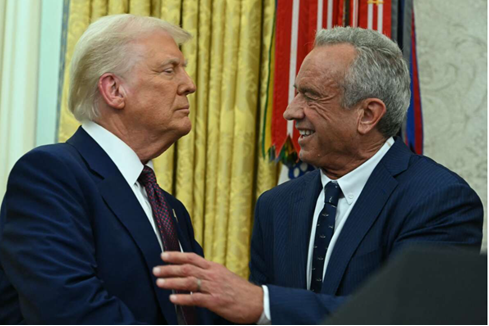
In a statement accompanying the announcement of Risch to the cancer panel, HHS Secretary Robert F. Kennedy Jr. — himself a promoter of anti-vaccine sentiments and conspiracy theories — claimed that Risch will “confront the factors driving cancer rates, and provide the public with science they can trust.”
Risch expressed appreciation for his appointment. “I am thankful for the opportunity President Trump has given me to transform cancer prevention in the United States,” he said.
Risch has previously faced criticism for his views on COVID vaccines.
In 2023, Risch postulated a possible link between mRNA-based vaccines, like those used in some COVID shots, and supposed “turbo cancers” — parroting the debunked conspiracy theory that cancer is sped up in people who receive such vaccinations. Risch expressed his views on a conservative podcast, suggesting that rising rates of cancer in young people could be connected to the vaccines.
Most experts agree, however, that generational differences in diet, lifestyle, smoking, and alcohol consumption are likely to blame for higher cancer rates. There is no scientific evidence backing Risch’s beliefs, and indeed, the rise in cancer diagnoses for young people pre-dates the availability of COVID-19 vaccines.
“There is no evidence that COVID-19 vaccines cause cancer, lead to recurrence, or lead to disease progression,” the National Cancer Institute says on its website.
In the same interview, Risch claimed that vaccines have done “various degrees of damage to the immune system,” leading to people “getting COVID more often” or “getting other infectious diseases” and “perhaps cancer in the longer term.” Those claims are disputed by studies and experts, who widely agree that the immune system is not detrimentally affected, overall, by COVID shots, and that vaccines reduce the likelihood of a person contracting COVID.
Risch also offered errant advice in the first few months of the pandemic. In May 2020, he argued in favor of using hydroxychloroquine as a treatment method for COVID, despite no evidence suggesting that the antimalarial medication would be effective in treating COVID. At the time, federal health officials opposed using the medication, although President Donald Trump had wrongly claimed it was a “game-changer.”
Multiple studies later found that hydroxychloroquine was ineffective at treating coronavirus.



https://shorturl.fm/2QZLT